
In my opinion, the RecId (the “5637312576” part in the example) is unnecessary. Consider the arguments:
- The voucher number is unique in every journal line, unless the Voucher series parameter at the Journal name is set to Manual or One voucher number only, or the Number allocation at posting is activated. All three setups are truly exotic in Dynamics 365 for Finance implementations for a number of reasons:
- The One voucher number only option contradicts the recommended GL master setting [Dis]allow multiple transactions within one voucher. An attempt to post is going to produce 2 error messages for every journal line – “There can only be one vendor or customer transaction per voucher.” and “There can only be one bank account transaction per voucher.“
- The Number allocation at posting defies the purpose: in the unposted journal, the system assigns temporary voucher numbers, which are then replaced at posting. The SEPA pain.001 file is made before posting, and its EndToEndId is going to hold the temporary voucher number: <EndToEndId>Temp001-5637312576-02</EndToEndId>. But such a line cannot be reconciled with the Modern bank reconciliation (see Matching own payments in Modern bank reconciliation), since the bank transaction will receive a different, the final voucher number on posting.
- The RecId has a low entropy: it is usually monotonously rising in a payment journal, since the lines are created all at once by the Payment proposal. The number of lines is typically below 1000, as a longer journal takes increasingly longer to post. Consequently, just the last 3-4 digits of the RecId are significant.
- In certain geographies, the EndToEndId may not be that long (India: 16 characters only). Truncating from the right will remove the important attempt counter, and the bank upload will fail on a second attempt. Truncating from the left will corrupt the voucher number: now the bank statement reconciliation will fail.
I suggest replacing CONCATENATE(@.PaymentIdentifications.EndToEndIdentification, "_", LEFT("00", 2-LEN(@.'$paymentEnumerator')), @.'$paymentEnumerator') in model.Payments.$PreprocessedEndToEndId …
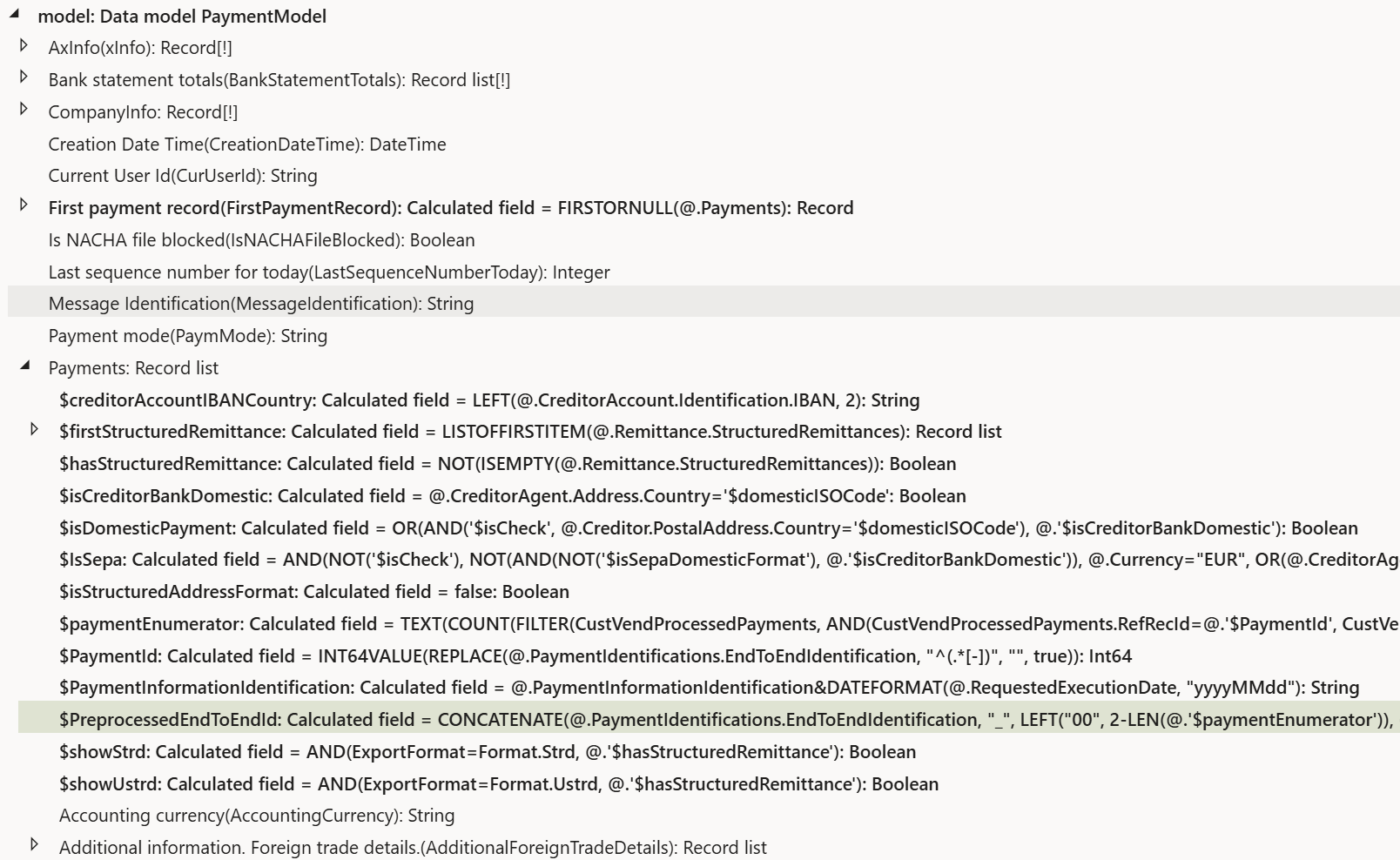
…with CONCATENATE(REPLACE(@.PaymentIdentifications.EndToEndIdentification,”-\d+$”,””,true),”_”, LEFT(“00”, 2-LEN(@.’$paymentEnumerator’)), @.’$paymentEnumerator’)
This eliminates the last group of digits together with the trailing “-” from the EndToEndIdentification element, and the result is going to be like this:

The input is the EndToEndIdentification stripped of the preceding voucher number up to the last “-” i.e. the RecId at the end. The result is a short deterministic string at the place of the longer RecId number:
<EndToEndId>APP-0036644UUT29</EndToEndId>
<EndToEndId>APP-0036645UXO01</EndToEndId>Electronic reporting blog series

Further reading:
Customer invoice falsifier for D365 for Finance
Amend GDPdU = GoBD = FEC
Z4-Meldung an Bundesbank
Enumerate lines in Configurable Business Documents
D365 Electronic Reporting: JOIN records in pairs
Electronic Reporting (ER) Cookbook 4: References in a model
Electronic reporting for data migration
Electronic Reporting (ER) Cookbook 3: Working with dates
Electronic Reporting (ER) Cookbook 2: new tips from the kitchen
Electronic Reporting (ER) Cookbook